
What Are Crypto Bridges? How They Work & Key Safety Risks
Learn how blockchain bridges move tokens across networks, compare lock-and-mint vs. liquidity bridges, and follow five steps to avoid bridge scams.
Blockchains do not naturally talk to one another. If you hold ETH on Ethereum Mainnet and want to use an app on Arbitrum, Base, or BNB Smart Chain, sending funds directly to another network will not convert them automatically. That is the exact problem crypto bridges solve—yet bridges also sit near the top of DeFi’s all-time exploit list.
Understanding how bridges move value under the hood makes it much easier to pick safer routes and avoid fake lookalike bridge websites.
What Is a Crypto Bridge?
A crypto bridge is a smart-contract protocol or network service that lets users transfer tokens or data from one blockchain to another. Because tokens cannot physically leave their native ledger, a bridge coordinates a deposit on the source chain and releases an equivalent asset on the destination chain.
Without bridges, every blockchain operates like an isolated island with its own tokens, rules, and gas fees.
The Two Main Ways Crypto Bridges Work
Most cross-chain bridges rely on one of two underlying architectures: Lock-and-Mint or Liquidity Pools. Each carries different speed, fee, and security trade-offs.
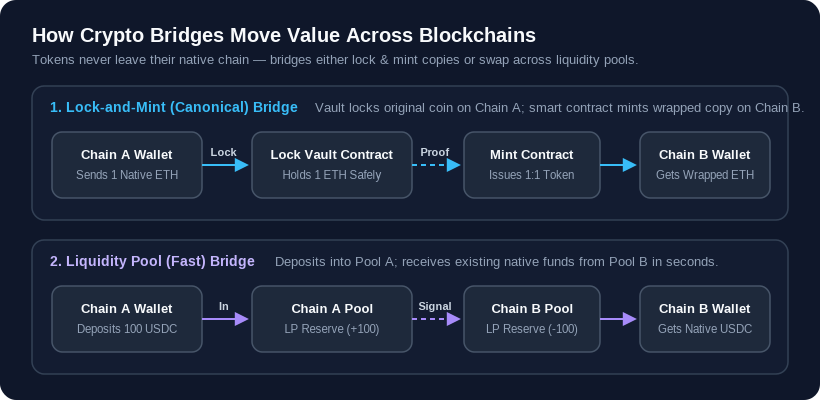
| Feature | Lock-and-Mint (Canonical) Bridge | Liquidity Pool (Fast) Bridge |
|---|---|---|
| How It Works | Locks your original token in a vault contract on Chain A and mints a wrapped copy on Chain B. | You deposit native tokens into a pool on Chain A; the bridge pays you native tokens from its pool on Chain B. |
| Typical Speed | Minutes for deposits; up to 7 days for optimistic rollup withdrawals back to Ethereum L1. | Usually 10 seconds to 3 minutes. |
| Asset Received | Often a bridged or wrapped representation of the asset. | Native asset on the destination chain (subject to pool liquidity). |
| Main Technical Risk | If the lock vault on Chain A is drained, minted tokens on Chain B lose their backing. | Pool imbalances can cause higher fees or temporary wait times during spikes. |
Example: Moving $200 of ETH to a Layer-2 Network
Suppose you hold $200 worth of ETH on Ethereum Mainnet and want lower transaction costs on a Layer-2 rollup:
- You open the rollup’s official canonical bridge or an established liquidity bridge.
- You approve and submit a deposit transaction on Ethereum Mainnet (paying one Ethereum L1 gas fee).
- After block confirmation—typically a few minutes—your wallet shows the ETH balance on the Layer-2 network at the exact same
0x...address.
For a closer look at why EVM networks share the same address format while staying completely separate, see our BEP-20 vs. ERC-20 comparison.
Why Crypto Bridges Are Frequent Hack Targets
Historically, cross-chain bridges have accounted for several of the largest hacks in Web3. Three structural factors explain why attackers focus on them:
- Massive Honeypot Vaults: Lock-and-mint bridges hold hundreds of millions of dollars inside a single smart contract vault. One bug in signature validation can expose the entire reserve at once.
- Complex Cross-Chain Verification: Verifying that an event truly happened on Chain A so Chain B can safely release funds requires relayers, validator committees, or cryptographic proofs. Any weak link in that verification pipeline can be abused to forge fake deposit messages.
- Phishing Lookalike Domains: Even when a bridge’s smart contracts are rock-solid, scammers buy search engine ads pointing to clone websites that request malicious wallet approvals instead of genuine bridge deposits.
5 Practical Safety Steps Before Using Any Bridge
- Bookmark Official URLs Only: Never click the top sponsored search result for a bridge name. Start from the destination blockchain’s official documentation or block explorer portal.
- Send a Small Test Amount First: Before bridging a meaningful sum, transfer a small test amount—say $10 to $20—and confirm it arrives properly on the destination chain.
- Check You Have Destination Gas Ready: If you bridge USDT onto a fresh network where you hold
0of the native gas coin (like BNB or ETH), your tokens will sit stuck until you acquire gas on that chain. Some modern bridges offer a small optional “gas refuel” toggle during checkout. - Compare Against Direct Exchange Withdrawals: If you already use a reputable centralized exchange that supports deposits on Chain A and withdrawals on Chain B, routing through the exchange can sometimes cost less in gas and avoid smart-contract bridge risk—though it introduces custodial exchange trade-offs.
- Review Approvals Afterward: After completing a bridge transfer with ERC-20 or BEP-20 tokens, check your active allowances periodically. Follow our token approval revocation guide to keep old permissions clean.
Frequently Asked Questions
Are official Layer-2 bridges safer than third-party bridges?
Native rollup bridges (canonical bridges maintained by the Layer-2 protocol itself) generally rely directly on Ethereum’s settlement security rather than an external validator committee. However, withdrawals back to Ethereum Mainnet on optimistic rollups can take up to 7 days, which is why many users compare trade-offs with audited liquidity bridges.
What happens if a bridge transaction gets stuck?
First, copy your source transaction hash into the source block explorer (like Etherscan or BscScan) to verify it actually confirmed. Many “stuck” bridge transfers simply wait for finality confirmations or require clicking a manual “Claim” button on the destination chain. Never accept unsolicited help from strangers in chat groups offering to “push” or “sync” a stuck bridge transfer.
Do I need to create a new wallet address on the destination chain?
Between EVM-compatible networks (such as Ethereum, BNB Smart Chain, Arbitrum, Optimism, Polygon, and Base), your self-custody wallet uses the same 0x... address. When bridging to a non-EVM chain (like Solana or Bitcoin), you must provide a separate destination wallet address compatible with that network.