
Address Poisoning Scams in Crypto: Spot Fake Wallet History
See why zero-value transactions appear in your wallet history, how crypto address poisoning tricks users, and four habits that stop it completely.
Open your transaction history on BscScan, Etherscan, or a mobile wallet and you might notice something strange: a 0 USDT or $0.001 transfer coming from an address that looks almost identical to your own—or identical to an exchange address you sent funds to yesterday.
That weird entry is rarely a glitch. It is usually an address poisoning attack, a social engineering scam designed to trick you into copying the attacker’s wallet address by mistake.
What Is Address Poisoning?
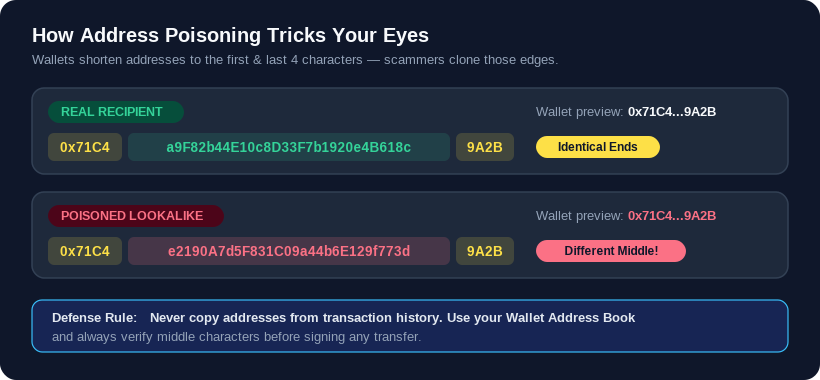
Address poisoning is a crypto scam where an attacker sends tiny or zero-value spam transactions to your wallet from a lookalike “vanity” address. The attacker generates an address matching the first and last few characters of an address you recently used, hoping you will copy-paste it from your transaction history on your next transfer.
Because your wallet cannot block incoming public transfers, seeing a poisoned transaction in your history does not mean your wallet has been hacked. Your private keys and seed phrase are still safe—as long as you do not accidentally send money to the lookalike address.
How the Lookalike Address Trick Works
Most people check only the first four and last four characters of a 42-character hexadecimal address before hitting Send. Automated GPU scripts can generate a brand-new wallet matching those edges in seconds.
Look closely at these two addresses side by side:
| Role | Full Address | What Most People Glance At |
|---|---|---|
| Real Recipient | 0x71C4a9F82b44E10c8D33F7b1920e4B618c9A2B |
0x71C4...9A2B |
| Poisoned Lookalike | 0x71C4e2190A7d5F831C09a44b6E129f773d9A2B |
0x71C4...9A2B |
At a quick glance inside a wallet activity feed, both appear as 0x71C4...9A2B.
Why Zero-Value Transfers Appear “From” Your Own Wallet
Many users panic when BscScan or Etherscan shows a 0 USDT transfer that appears to leave their own wallet without their permission.
Certain ERC-20 and BEP-20 token contracts allow any third party to call transferFrom(victimAddress, attackerLookalike, 0) even with zero allowance, because transferring 0 tokens changes nobody’s balance. The blockchain records the 0-token event anyway—planting the scammer’s lookalike address neatly at the top of your recent activity list.
Address Poisoning vs. Dusting Attacks
Both scams send unsolicited tiny transactions to your wallet, but their goals differ:
- Address Poisoning: Aims to make you copy the wrong recipient address from your wallet history and send real funds straight to the scammer.
- Dusting Attacks: Send microscopic amounts of coins (worth fractions of a cent) to thousands of wallets so analysts or scammers can track linked outputs when you spend them—or attach spam token names advertising phishing websites.
In both cases, the first rule is identical: ignore the unsolicited transaction completely. Do not try to swap unknown spam tokens that suddenly appear in your wallet, as they often lead to fake claim sites or honeypot contracts.
4 Habits That Prevent Address Poisoning 100%
- Never Copy Addresses From Transaction History: Treat your wallet’s activity feed and block explorer transfer tab as read-only logs, never as a contact list. Always fetch the recipient address fresh from the destination wallet or exchange deposit screen.
- Use Your Wallet’s Built-In Address Book: Save frequently used personal wallets and verified exchange deposit addresses as named contacts inside MetaMask, Rabby, Trust Wallet, or your hardware wallet app.
- Check Characters in the Middle, Not Just the Ends: Verify the first 6 characters, a block of 4–6 characters in the middle, and the last 6 characters—ideally on a hardware wallet screen before signing. Read our guide on hot wallets vs. cold wallets for safer signing setups.
- Enable Spam Filters and Send Test Transfers: Reputable wallets and explorers like BscScan and Etherscan include toggles to hide zero-value token transfers. For larger transfers, send a tiny test transaction first and confirm arrival before sending the remainder.
Frequently Asked Questions
If I see a 0 USDT transfer in my history, do I need to move my funds to a new wallet?
No. A zero-value poisoning transfer does not mean your seed phrase or private key was compromised. Simply ignore it, do not copy any address from that log, and double-check that you have not granted any unknown contracts spending permission using our token approval revocation guide.
Can a stolen transfer from address poisoning be reversed?
No. Once you confirm a blockchain transfer to an attacker’s lookalike address, the transaction is permanent and irreversible. Prevention at the copy-paste step is the only reliable defense.
Do modern wallets warn about lookalike addresses?
Several modern wallets and block explorers now flag zero-value spoof transfers or highlight when a pasted address resembles a known poisoning pattern. Still, never rely exclusively on automated warnings—always pull addresses from saved contacts or the original source.